
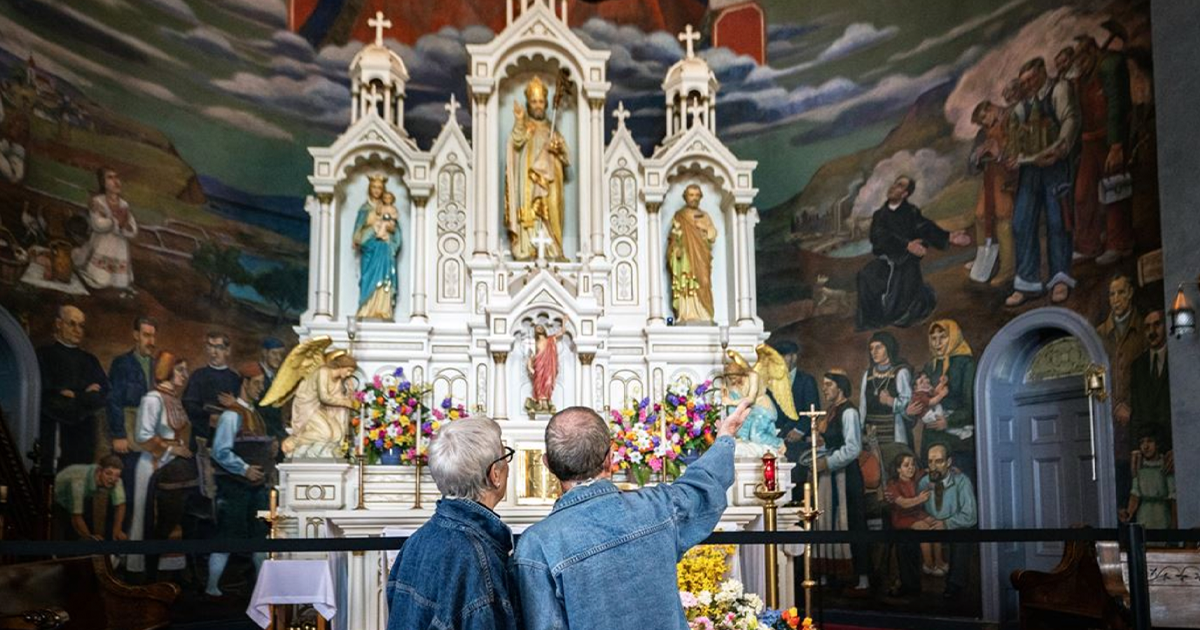
Pittsburgh Post-Gazette – On a blustery afternoon at the hilltop grounds of Millvale’s St. Nicholas Croatian Church, the Society to Preserve the Millvale Murals of Maxo Vanka held a free block party designed to draw the public into one of Pittsburgh’s most striking, and often overlooked, artistic treasures.
The Sunday event blended education with play. Visitors posed at a selfie station dressed as figures from the murals, painted pieces of a community grid mural, entered raffles and sampled free cookies and pierogi. For many, it was their first encounter with the vivid, socially charged paintings of the Croatian artist.
The block party, now in its fourth year, reflects the organization’s dual mission: preserving the murals and making them accessible. Founded in 1991, the society has spent decades raising funds and awareness to conserve the fragile works, which Vanka painted mostly during two periods, in 1937 and 1941. Sunday’s turnout — expected to approach 700 people — shows how far that effort has come.
“This is really a community event,” said Anna Doering, executive director of the society. “It’s really just to open the doors. … A lot of people say, ‘It’s always been on my list to come and see the murals. This seemed like the perfect day.’”
Doering estimates that the society had raised about $3 million from public and private donors, as well as from the society’s tours, for conservation, roof repairs and climate control — investments aimed at safeguarding murals that were not designed to last.
Vanka wasn’t really thinking ahead when he began painting his murals in the Millvale church nearly 90 years ago.
That’s what has created the Sisyphean work of conservators. Murals are ideally painted as frescoes — paint applied to wet plaster so the image becomes a part of the wall. Vanka, using whatever materials he had on hand over the years, painted directly on the dry plaster walls.
Water damage and soot from the environment and church incense took their toll.
“We started in 2010 to do tests, and there was water damage from the roof having some leaks,” said Patty Buss, a private conservator who has worked on the project for more than a decade. “And the murals had a lot of soot and dirt from the mills, from the traffic ….”
She points to a painted white handkerchief with a small black square in the middle, left as evidence.
“That’s how dark the whites were,” she said.
Using pH-adjusted distilled water, chemical poultices and careful retouching, conservators have worked in phases, a few months at a time, as funding allowed.
Ms. Buss described the work as “long” and “hard.”
Working from scaffolding, the work on the ceiling was particularly taxing because conservators had to crane their necks for hours.
“There were four of us working on this, and we would alternate every other day because our necks would get so stiff,” she said.
“It’s very satisfying though,” she added. “As you’re working, you see all the dirt come off and how beautiful the color is. He used vibrant color.”
She pointed to the constellation-strewn ceiling, which “became so vibrant, and you can actually see all the stars.”
Though conservation nears completion — it’s about 90% finished — the work is cyclical. Exposure to moisture, soot and time means earlier sections will eventually need renewed care.
For docents like Kathleen Roberts, who is also the executive director of Duquesne University’s Honors College, the murals’ power lies not only in their visual impact but also in their layered meaning. A volunteer guide since 2023, she sees Vanka’s work as a fusion of sacred tradition and social critique.
“I think he was trying to say a lot about social justice,” Ms. Roberts said. “He painted very traditional scriptural references … but he also used a black steelworker for the model of Jesus.”
Sometimes taking inspiration from sketches he made of people on the streets of Pittsburgh, Vanka tried to “incorporate so many of the stories of Pittsburgh and, in particular, the kind of social injustices of the time,” Ms. Roberts said.
That emphasis on lived experience has inspired the society’s newest initiative: a dedicated immigration tour series. Launched last month, the tours focus on the stories of the immigrant parishioners whose lives shaped the murals.
“The immigration tour is going to specifically focus on [murals] where the immigrant members of the parish are depicted,” Ms. Roberts said. “The murals that speak very much to their lives at the time and the history of immigration.”
Oral histories recorded by one of the society’s collaborators are part of the immigration tours.
Visitors on Sunday got a preview of those stories, along with the chance to explore at their own pace. Unlike formal tours, docents and conservators were stationed throughout the sanctuary, inviting conversation.
For some attendees, that invitation was enough to turn curiosity into commitment. Joe and Nicole Connor of Millvale brought their daughters Harper, 4, and Noa, 9 months, after noticing signs around town.
“We’ve seen signs for it all the time, and then we saw they’re doing the block party,” Joe Connor said. “I was like, we got to go check it out.”
Their verdict came quickly. “It was so fun!” Harper said.
“I think we’re going to come back and do a real tour,” Mr. Connor added.
Reactions like that are the goal.
For decades, the murals were, as the society’s Mary Beth Fazio noted, “just referred to as the wallpaper.”
Today, they are a destination.
Tour participants “come from everywhere,” Ms. Roberts said. Once they come, they will often bring visiting friends or family members.
“People are really captivated when they come. So they come over and over again.”